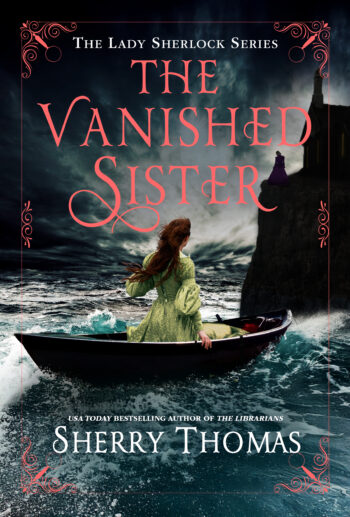
The Lady Sherlock Series, Book 9
Charlotte Holmes—aka Sherlock Holmes—becomes entangled in a puzzling missing person case that hits close to home for her beloved Mrs. Watson in this Victorian-set mystery from the USA Today bestselling author of A Ruse of Shadows.
It’s been three years since Charlotte Holmes struck a decisive blow against Moriarty’s operations in Britain, three years of relative calm and benign developments. In a buoyant mood, everyone gathers at Lord Ingram’s seaside cottage in North Devon for what promises to be a perfect summer holiday. Until Mrs. Watson receives an invitation from Mrs. Carstairs, her long-estranged sister, to attend a house party nearby.
Mrs. Carstairs has married spectacularly well. She is the mistress of a great manor, a doyen of all domestic arts, and still an unforgettable beauty. Now she clamors for a reconciliation with her sister. Mrs. Watson does not trust Mrs. Carstairs’s motives. Yet she cannot help but feel tremors of the old admiration for this once-beloved sister.
Then Mrs. Carstairs disappears without a trace. The next day a woman is discovered floating on the waves, her build and coloring matching those of Mrs. Carstairs. But her husband insists that the corpse fished out of the Bristol Channel cannot be his wife. So where is the real Mrs. Carstairs? Would she have purposely dragged Mrs. Watson into a murder investigation? Or was it Sherlock Holmes’s involvement that she needed from the very beginning?
1866
In the antique bassinet, baby Penelope slept under a Honiton lace–trimmed blanket, her lips slightly apart, her cheeks round and pink.
Joanna Redmayne gazed at her daughter, tears spilling down her face.
No great misfortune had befallen either herself or Penelope. To the contrary: Joanna had been singularly blessed. She, not the greatest musical theater actress, had gone on to an enviable career as a demi-mondaine. And now, His Grace the Duke of Wycliffe, her protector and Penelope’s father, was about to make her the de facto mistress of Eastleigh Park, his sprawling country seat.
But this opportunity, as all opportunities did, came with a cost: Penelope would not be there. She and her nanny would lodge in a cottage several miles away and Joanna would be lucky if she could spend an hour a day with her child.
The duke’s declining health was the reason he no longer wished to travel to visit Joanna; over the objection of his two eldest sons, he would install her at Eastleigh Park. His doctors believed that he had only six months to live, but Joanna had known invalids who outlasted their younger, healthier caretakers. When the duke’s time finally came, would Penelope still rely wholeheartedly on Joanna, or would she only know Joanna as the harried woman who was always leaving to do other things?
She touched Penelope’s downy head, so soft, and still so comically bald, as Joanna herself had been at that age, according to her late grandfather.
A light rap came at the nursery—that would be Polly Banning, one of the housemaids. There was still much to do before everyone could decamp to the country. Joanna wiped her eyes and went to the door.
Polly Banning bobbed a curtsy, her eyes alight with curiosity. “Mum, there’s a lady to see you, a real grand lady.”
That would explain Polly’s interest. Ladies, especially “real grand” ladies, did not call on the likes of Joanna Redmayne.
“She said her name is Mrs. Carstairs,” Polly continued, “and that you’d wish to receive her.”
Joanna blinked. Justina.
Justina had not indulged in hysterics when she learned that her little sister intended to try her luck onstage. Instead she’d issued a cool warning that they’d no longer be family, as she herself planned on remaining eminently respectable.
Several years later, when news reached Joanna that Justina had become a vicar’s wife, Joanna had thought that the pinnacle of respectability. But after the passage of some more years, Justina, widowed and mother to a little girl, had achieved a spectacular remarriage and nabbed the master of Noble House.
Joanna, watching from afar, could only marvel at her sister’s rise in the world. With no small degree of envy.
Belatedly, she realized that Polly was still waiting for an answer. “Yes, you may show her to the parlor. Use the Sèvres. And tell Madame Gascoigne to do her best for the tea tray.”
Not that she could ever keep a house as beautifully as Justina did. And not that it mattered. To the grand ladies of the world, Joanna might as well be a parrot: Even if she recited entire speeches by Cicero, she still belonged to a different and inferior species.
But Justina wasn’t just any other lady of the manor, she was Joanna’s sister. They might not have been inseparable, but they’d still grown up together. And while they had not truly understood each other, no one knew where Joanna came from better than Justina—and vice versa.
Joanna changed into a new frock that had arrived from the modiste only two days ago, a rampage of butterflies in her stomach. She, of course, could never call on Justina to see her children. But a secret visit or two from Justina wouldn’t affect Justina’s standing in the same way.
Could it be? Was Justina here to see Penelope?
She descended the stairs quietly, as if a sudden noise might cause her sister to flee. As she opened the door to the parlor, the woman inside looked up.
An admirer once gushed that Justina made him think of the Taj Mahal at sunrise, an entity of grandeur, delicacy, and symmetrical perfection. That was, of course, an absurd exaggeration, but there was no disputing Justina’s beauty.
Joanna had always turned heads, too. But she must put in some effort to light up a room. Justina? To be luminous, Justina needed only to exist.
Fourteen years had flown by since they’d last seen each other at their grandfather’s funeral, two black-clad young women with ambition burning in their hearts. Now, for the first time, Joanna understood the comparison with Taj Mahal.
Then Justina had been too young and, for the lack of a better descriptor, too poor to be likened to a monument that had cost the equivalent of six million pounds sterling. An unpolished diamond, no matter how pure of composition, still resembled a fragment of glass.
Fourteen years later, she was a diamond of untold facets, the worthy centerpiece of a crown.
“What brought you here today, Justina?”
Her sister looked her over, her gaze calm, level. “You look well, Joanna.”
“By the grace of God I have not perished in a London tenement, as you so confidently predicted,” said Joanna a little huffily.
“I’ve never been a prophet,” said Justina with perfect equanimity.
She poured two cups of tea and offered Joanna one. Somehow, next to the elegant simplicity of her visiting dress, the Sèvres set, Joanna’s pride and joy, with its double-walled surfaces that resembled Chinese windows, suddenly seemed too much. Too much fretwork, too much gilding, too elaborate and fussy for any actual use.
Joanna perspired in her stiff new frock.
“Congratulations on the baby, by the way,” said Justina. She opened her reticule and took out a wrapped present. “I’ve a gift for her for when she’s a little older.”
“Oh,” said Joanna. She’d never prepared gifts for Justina’s children—they would have been returned unopened.
The bow atop the box was made of pink ribbon, the double loops small but perfect. “Thank you,” said Joanna. “I’m sure Penelope would like it.”
“Have you thought about how she’ll be introduced to the world? Will the duke marry you for her sake?”
It was not unheard of for a man to marry his mistress at the end of his life. That and an act of Parliament would ensure Penelope’s legitimacy.
Joanna shook her head. The duke’s two eldest sons, as a condition for allowing Joanna to live at Eastleigh Park, had extracted a promise from their father that he would not marry her on his deathbed—or before that.
“Then have you found someone to marry you, someone willing to sign his name to a marriage license and claim Penelope as his own?”
Joanna again shook her head. Between the baby and the duke’s health, she hadn’t had time to think properly, let alone seek out such a man, a man she would have had to trust without reserve.
She loved Penelope more than air and water, but she could never envision the child’s future without a stab of anxiety. Her father held one of the greatest hereditary titles in the country, her half brothers were highborn, the eldest a future duke himself. But where would Penelope belong? Could she ever achieve the kind of simple respectability that Joanna had given up when she decided to step onto the stage?
“What if you say that she’s Cousin Gordon’s orphaned daughter whom you’ve taken in out of charity?”
Their cousin Gordon Redmayne’s child had been born a few months before Penelope. The entire family, however, had succumbed to the wave of influenza that struck Britain not long after.
That would be a convenient solution but Joanna did not feel a leap of joy. In fact, she shuddered at the thought of being called Cousin Joanna by her own child.
“Wouldn’t people wonder why I’m the one charged with Cousin Gordon’s baby when you’re right there?” she asked rather weakly.
Justina sighed.
With that trace of melancholy, her beauty only became more striking, the Taj Mahal under the glow of moonlight, perhaps.
Once upon a time, Joanna had considered Justina’s looks a little one-note. Once upon a time, she’d considered Justina herself a little one-note, obsessed with everything around her appearing just so. But the passage of the years had endowed Joanna with a stillness that made Joanna want to ascribe to her a great wisdom to go along with that great beauty.
But should she? Had Justina ever been sage, or only ruthlessly practical?
“Why are you so concerned for the well-being of my child, Justina? What is it that you really want?”
Justina took a sip of her tea. “Have I ever stood in the way of what you wanted, Joanna?”
“No.” That much Joanna had to acknowledge: Justina could have leaked Joann’s plans to their grandfather and Joanna would have been racked with guilt for disappointing the dear old man.
“And I would have left you and your child alone. I’m happy that you’re still alive, Jo, happy that your dreams haven’t destroyed you. But remember what Grandpa used to tell us? All opportunities carry costs. The cost of my marriage is that my husband also has a say in such matters and he does not wish for his children to have an illegitimate cousin.”
Joanna wanted to lash out—one could not catch illegitimacy. But unfortunately she understood all too well how being related to fallen woman affected a sister—somehow it was always the mothers and the sisters who had to answer for the choices of a woman gone astray, and bear the damage to their own reputation.
“If having a demi-mondaine for a sister did not prevent your marriage to Mr. Carstairs of Noble House, how will Penelope lessen your children’s exalted stature?”
Justina did not answer immediately.
She’d used to be more voluble and forthcoming with her opinions, especially on the harebrained things Joanna was often up to. In the silence that rippled and warped, Joanna heard everything Justina chose not to speak aloud.
Have you ever felt the loneliness of a woman not to the manor born, standing before the senior servants of a great house? Have you ever felt lost in a web of bloodlines and other connections that stretches across centuries and half the country? And have you ever feared that your child would be regarded as the lesser, because you were once a woman of no consequences whatsoever?
Or were those Joanna’s own fears echoing in her head?
“I did not wish to make this trip,” said Justina softly. “Not that I didn’t want to see you, but I did not think you would be amenable to Mr. Carstairs’s request.”
A chill crept across Joanna’s heart. “But you made the trip nevertheless.”
Justina exhaled. “Do you recall how we wished to meet gentlemen when we were girls?”
Memories inundated Joanna. The two of them in their mother’s old dresses, floating down the staircase of the vicarage, taking turns being the belle of the ball or the ardent swain waiting at the newel post.
“But gentlemen in reality,” continued Justina, “especially the masters of the manor who need to answer to no one, are a different species from you and I.”
This was too sweeping a statement, but Justina wasn’t all that far off the mark. As long as a gentleman did not cheat at cards—that is, defraud his own kind—he never stopped being a gentleman. Given that sort of latitude, it was a miracle that some of them did not turn out entirely rotten.
Joanna regarded Justina warily. “So what edict has your husband handed down?”
“He asked me to remind you that your happiness and security—as well as Penelope’s—rests on the flimsy foundation of a man’s belief that you are the mother of his child.”
Air disappeared from Joanna’s lungs. Fear, like lead, sank slow and dark through her bronchi.
The world already considered women like her to be without honor or decency. What would it take to plant a seed of doubt in the duke’s mind? A rumor? A few rounds of gossip? One man openly ridiculing one of the duke’s sons about it?
Ironically, it was not cheap being a demi-mondaine. A fallen woman had to spend a small fortune to look elegant and expensive, so that a man wouldn’t conclude that her services cost merely a few frocks and a good supper now and then. Joanna had some money put away, but not enough to protect Penelope and herself from the predations of the world. She needed the settlement that the duke had promised her—promised but not yet signed over.
But more than that, she did not want to test the duke’s trust in her—or his character. She had seen what other gentlemen had done when they believed their mistresses to have strayed and it had not been pretty.
She must look stricken. Justina regarded her solemnly. “I’m sorry. You’re right: Your profession did not impede my very advantageous match. Yet in return, you must share in the cost of my marriage.”
She rose. “Let me at least have the grace to make myself scarce. I apologize again, Joanna. Good luck.”
Joanna stared at her sister’s lithe figure until she disappeared. And then she move jerkily to the window, to watch Justina’s gleaming town coach, the very image of propriety and refinement, roll away down the street.
Did she believe Justina’s claim that she’d come at the behest of a narrow-minded husband? Maybe. Maybe Mr. Everett Carstairs of Noble House was just the sort to be bothered by the thought of an illegitimate niece. But the direction of the attack, the threat against Joanna? A woman had thought of that, a woman who understood the fragile nature of female credibility.
And Justina had always cared, down to the least minutiae, how she appeared to others.
Joanna stood in place until she heard whimpers from the nursery. Her tears fell freely again. How she had looked forward to the first time her baby would call her Mamma—and all the sweet repetitions of that most beautiful appellation. But now she would never have it. Now her child would mourn for some other woman when Joanna stood right there, unable to tell her the truth.
“I’m coming!” She permitted herself to say it for the very last time. “My love, Mamma is coming.”
August 1890
On the coast of North Devon
What a perfect day, thought Mrs. Watson drowsily.
A breeze billowed the sails of the gaff-rigged sloop. To the starboard stretched the sunlit waters of the Bristol Channel, the silhouette of Wales faintly visible in the distance. On the other side reared the magnificent coastal bluffs of North Devon, carpeted in purple heathers.
They were sailing due west, but the green-lensed carriage specs Mrs. Watson sported—a fashionable gift from her dear Penelope—blunted the strongest rays of the afternoon sun. Across from her, Miss Charlotte Holmes examined the inside of their picnic hamper with the solemn concentration of an archeologist.
Mrs. Watson wanted to laugh—the dear girl would not find much. They’d sailed to Lynmouth this morning and, despite Miss Charlotte’s preference for the newly constructed cable railcar, zigzagged up the steep path on foot to the clifftop hamlet of Lynton.
From there they’d explored the otherworldly Valley of Rocks, noted for its unusual rock towers, and walked past the abbey to Woody Bay before returning to the outskirts of Lynton for a picnic luncheon.
The picnic hamper, which had traveled up the cable railcar in the care of Mr. Mears, Mrs. Watson’s butler, had seemed a veritable cornucopia. Yet it had proved barely sufficient for the appetites of six hungry ramblers in addition to Mr. Mears himself. Mrs. Watson, who usually watched what she ate, had indulged in two large servings of a glistening tart, topped with wild raspberries they themselves had harvested near Lord Ingram’s seaside cottage.
“I thought there was nothing left of the food,” said Miss Olivia Holmes from the bow of the vessel, where she sat next to Mr. Marbleton.
“It’s all gone,” replied Miss Charlotte. “I am but surveying the scene of the carnage. Does anyone want limeade, by the way? If we finish that, too, then we can claim total victory.”
Penelope’s bell-like laughter rang out. “Well, if you put it like that, then of course we must do all we can for total victory.”
Mrs. Watson chortled as she sank more deeply into the pleasant woolliness that was the inevitable byproduct—at least at her age—of vigorous exercise followed by a great deal of delicious food.
She felt Penelope leaning forward and heard the splash of limeade falling into a cup. Lord Ingram, at the helm, asked whether they ought to sail faster so that they’d sit down to tea sooner. “No need,” replied Miss Charlotte. “Let’s not jostle Mrs. Watson.”
Mrs. Watson meant to protest that she didn’t mind a little jostling in exchange for greater speed. But the words, right on the tip of her tongue, disappeared into the ether. And it was so very agreeable, their current pace, bobbing just enough to let her feel the boat’s progress.
Rather like how life had been in the past three years, ever since Miss Charlotte had outmaneuvered Moriarty: more or less smooth sailing for the two women responsible for the operations of Sherlock Holmes, consulting detective.
In fact, with Moriarty in hiding, life had been good for everyone on the sloop.
Penelope, five years into her seven-year French medical education, remained fascinated by everything that could go wrong—and right—with the human body.
Lord Ingram had written a well-received archeological treatise on Celtic Britain and gone on a standing-room-only lecture tour the previous year. His children thrived in spite of the absence of their mother. And at thirty-one, he was fitter and more striking than ever.
Miss Olivia thrilled Mrs. Watson by publishing not one but two novels featuring the great consulting detective. In addition, she’d written several short stories in which Sherlock Holmes flexed his deductive prowess, with the goal of making them available as a collection at a later date.
Mr. Stephen Marbleton, Miss Olivia’s beau, had perhaps profited the most from Moriarty’s retreat: After losing his entire operation in Britain, he’d left the Marbletons, his sworn enemies, alone.
As a result, Mr. Marbleton no longer needed to be constantly on the move, as had been the pattern his whole life. This greater stability worked wonders for his courtship of Miss Olivia. Instead of always meeting each other in passing, he could now remain near her for an extended period of time.
“I will never not love the sea and I would like to live within view of it, if possible.” Miss Olivia’s words, despite the enthusiasm in her voice, sounded a little faint. “Not directly hanging on a cliff over the waves, as much as I love that house in Lynton—the one that you said used to have a private cable car—but a mile or so inland, with the sea in walking distance.”
“My cousin has a place on the Sussex downs that might be perfect for you,” said Lord Ingram, his words too a bit indistinct, for all that he stood only a little aft of Mrs. Watson.
“Really?” Miss Olivia’s voice was becoming inaudible. “I like Sussex. It’s sunnier than . . .”
Mrs. Watson rested her head on Penelope’s shoulder. The dear girl only ever smelled of good Provençal soap, not like Mrs. Watson, who used to reek of attar of jasmine.
You can’t live like this, Joanna. You can’t waste so much money on perfume and other fripperies.
How odd. She actually agreed with Justina’s chastisement. She had been too spendthrift and her purchases had been no proper essence, but badly diluted who knows what. But ah, the joy she’d felt applying those drops to her inner wrists, the contentment of feeling a veritable Salome at that silly, marvelous age . . .
“. . . very nice dress. What do you think, Miss Charlotte?” came Penelope’s voice.
“Oh, I agree. And that is probably a very beautiful woman, too.”
“Too bad we can’t see her face behind her binoculars,” said Miss Olivia.
“I wonder if she’s from that house on the bluffs.” Mr. Marbleton added his voice to the discussion.
Mrs. Watson slowly opened her eyes. The sun still shone. A few puffy clouds now drifted across the vast blue sky. Lord Ingram’s cottage, its terrace overhanging the bluffs, was visible a mile or so ahead. Were they that close to home then? How long had she slept?
She sat up straight and turned in the direction of everyone’s gaze. Two great conical outcrops, the Hangman Cliffs, came into view. Great Hangman, at just over a thousand feet in elevation, was the highest sea cliff in all of England.
But the sloop had already sailed past Great and Little Hangman, and now cut across the waters before a secluded beach. At the very edge of the precipice that loomed over the beach stood a slender figure in a white dress. Her skirts danced in the breeze; the long ends of a green sash belt levitated sinuously.
A pair of binoculars hid her face. She could be looking at anyone on the sloop, yet Mrs. Watson felt herself under scrutiny.
She tensed. “Who’s that?”
“The house across the bay from ours, the one you said you wanted to see up close? It’s hidden from us right now because the land dips down,” said Penelope cheerfully, “but it’s right beyond these bluffs, a quarter mile due south. What is it called again, Ash?”
“High Burrow.”
From the terrace of his cottage, one had a panoramic view of the Hangman Cliffs and the sheep-dotted moors beyond. On such an expanse of moorland, high above the little town of Combe Martin, perched a Gothic house that, at first glance, appeared incongruous with its surroundings.
Then again, such an edifice rather embodied the spirit of the age. Architectural vernaculars were ground together as if put through a vegetable mill and new owners transformed old dwellings with wild abandon.
“You think she’s from that house?” Mrs. Watson asked, staring. Something about the woman was familiar. Too familiar. The figure. The air of authority. That head of shiny chestnut hair, not a strand out of place despite the air currents.
“Could be,” answered Lord Ingram. “I’ve not met the family.”
Abruptly, the woman turned around and walked away, disappearing rapidly. Mrs. Watson let out a breath, released her fingers from around the gunwale, and slowly turned around. “So who owns High Burrow?”
“The Carstairses of Lincolnshire,” said Miss Charlotte, looking directly at Mrs. Watson. “Have you heard of them?”
Lord Ingram’s seaside cottage was a cottage in roughly the same sense that Chatsworth House was a house. He had bought it as a present for his former wife, who, as it turned out, had no use for it. For years it sat empty, seldom visited by either husband or wife, and certainly not the two together with their children. At one point it only had a single elderly caretaker who could barely keep up with the grounds, let alone cook and clean for visitors.
But things had changed since Lord Ingram’s divorce. Or rather, since he took up with Miss Charlotte. Lord Ingram, thoughtful man that he was, quickly realized that while Miss Charlotte could visit him occasionally in disguise at Stern Hollow, his country seat, it was much more convenient for everyone if she didn’t have to run the gauntlet of a large manor house that was both full of servants and surrounded by curious neighbors.
Subsequently, this long-neglected spot on the Devon coast became their love nest. It now boasted modern plumbing and a well-ventilated new kitchen, as well as new floors, new flues, new windows, and a new name. Mrs. Watson wasn’t sure what the place had been called earlier, but Miss Charlotte had dubbed it Sans Souci—French for Without Worries—and Lord Ingram had had the name engraved upon a plaque and affixed it to the gate.
Mrs. Watson, prone to fretting, had felt unusually carefree at Sans Souci. But as the company reached the cottage at the end of their otherwise idyllic excursion, she was anything but happy and assured.
In fact, she made sure not to look toward High Burrow, now a looming presence in the distance.
Mrs. Watson had not needed to answer Miss Charlotte’s question, for Miss Olivia had piped up at that moment, My goodness, that’s the family Philana Newell will be marrying into! I knew that they had a place somewhere on the Devon coast, but I had no idea it was so close to Sans Souci.
For the past three years, though Miss Olivia spent a good bit of time with Mrs. Watson and Miss Charlotte, she officially resided with Mrs. Newell, distant cousin and great friend to the Holmes sisters. The world believed her to be Mrs. Newell’s companion, though in truth she was more the latter’s guest at her dower house in Derbyshire, not far from Lord Ingram’s estate.
And so Mrs. Watson learned that Philana Newell, Mrs. Newell’s granddaughter, had become engaged recently to none other than the Carstairses’ younger son. Moreover, the Carstairses, who made use of their holiday house only sporadically, would presently be hosting the Newells at High Burrow to celebrate the engagement.
Miss Olivia deemed that the house party would not affect them and they’d continue with their own holiday as planned. But Mrs. Watson felt a tightening of her collar.
On the eve of this important social occasion for Justina, Mrs. Watson had blithely sailed by High Burrow, her grown-up daughter by her side, surrounded by their friends. Would Justina see that as merely the coincidence it had been, or would she extrapolate a wholesale insurrection on Mrs. Watson’s part?
The tea that welcomed the ramblers back to Sans Souci was a substantial spread. As everyone else tucked into cakes and sandwiches, Mrs. Watson badly wanted to fortify her cup with a dram of whisky, or at least some brandy. But such a beverage would be difficult to explain on a warm day . . .
Penelope was already proposing a game of tennis. When the cottage was renovated, Lord Ingram had added a tennis court and his guests had made good use of it.
“I’m still surprised that you do, in fact, play tennis.” Miss Olivia laughed as she addressed her sister. “You always wrote that ‘Games of tennis were played’ and I always imagined that someone was conscripted to play with Ash while you sat nearby with a Victoria sponge and a stack of books.”
“You’re not wrong about the Victoria sponge,” answered Miss Charlotte while biting into a slice of Victoria sponge. “Ash knows how to dangle a carrot. He always promises a grand picnic, but only after games of tennis or long rambles for which we must start at dawn.”
Miss Olivia tittered. “So you were the conscripted one.”
They scattered amid peals of laughter—which were beginning to take on a fey and brittle tone in Mrs. Watson’s ears—to change into tennis costumes. Mrs. Watson did so grimly and sat in her room for a quarter hour, her head in her hands, before she went down to join the company at the rear of the house.
Newly shorn grass, smelling of green sap and deep summer, fresh lines of chalk dust, laid down to mark the boundary of the court, young people in tennis whites stretching and limbering up—nothing but peace and unmarred contentment everywhere Mrs. Watson looked. Yet fear swirled in her heart.
“Where’s Ash?” asked Penelope.
As if to answer her question, their host emerged from the house and headed straight for Mrs. Watson, a slight frown on his face. “Ma’am, Mrs. Carstairs from High Burrow is here to see you. Are you at home to her?”


Berkley (September 29, 2026)
ISBN-13: 9780593640470
ISBN-10: 0593640470


Penguin Audio
September 29, 2026
Narrated by: Kate Reading
Length: 13 hrs
♦ Audible ♦ Apple Books ♦